
5 Mistakes to Avoid With Garage Door Parts
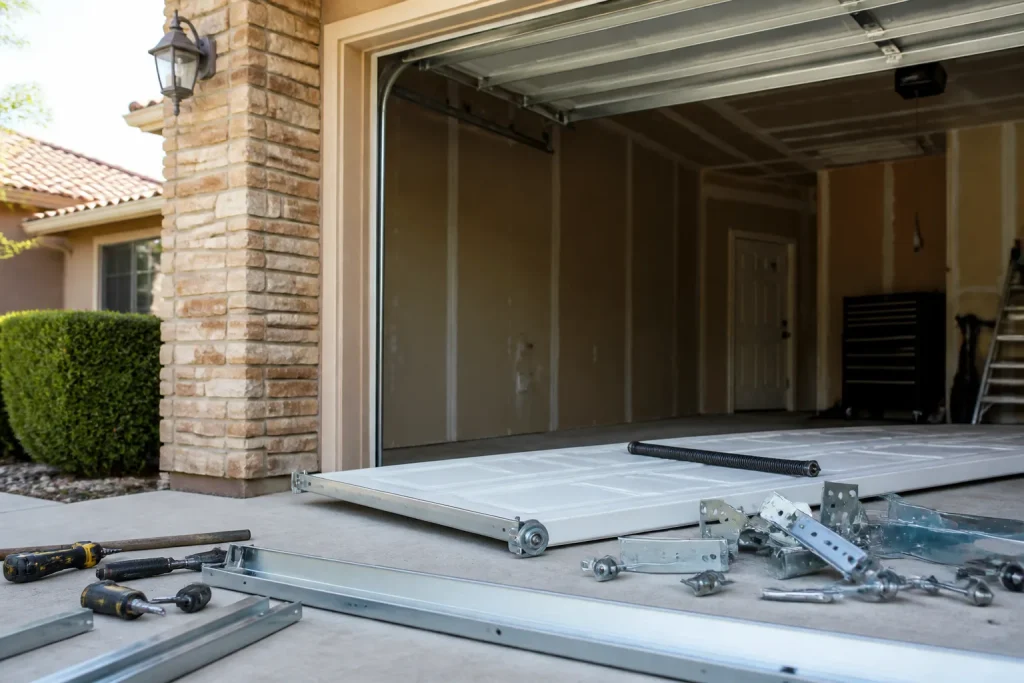
Homeowners in Sacramento who try to save money on garage door repairs often end up spending more by choosing the wrong parts or installing them incorrectly. The five costliest mistakes we see involve mismatched springs, uneven cables, wrong roller materials, over-tightened drums, and generic hardware that can’t handle the load. If you’d rather not risk a second repair bill, call Vanguard Garage Door California at (888) 430-4880 for a free estimate.
Last month we were out in Natomas fixing a door that had been “repaired” six months earlier with springs labeled “heavy duty” from an online retailer. The springs were fine. The cables were shredded, the drums were cracked, and the top fixture had pulled clean out of the panel. The homeowner’s logic was sound — buy stronger parts, get a stronger door — but garage door systems don’t work that way. Every component is specced to work as a matched set. Change one variable without accounting for the rest, and you create a cascade failure.
After 18 years in this trade and nearly 400 service calls across Sacramento, Henry Salazar and our team have catalogued the same preventable mistakes. Here’s what actually goes wrong, why it happens, and how to avoid it.
Mistake 1: Buying Springs Rated by Door Size Instead of Door Weight
A 16-foot-by-7-foot opening tells you almost nothing about what spring you need. That same opening could be a lightweight uninsulated steel door at 140 pounds or a thick, insulated Clopay or Amarr wood-grain panel system pushing 320 pounds. The spring’s job is to counterbalance the door’s actual weight so the opener doesn’t strain and the door stays put when half-open. Get this wrong in either direction and you’re asking for trouble.
Too light a spring, and your LiftMaster or Chamberlain opener grinds itself to death lifting dead weight every cycle. Too heavy a spring, and you overload the cable drums, the top fixtures, and the hinges. We’ve replaced drums in West Sacramento that looked like they’d been hit with a hammer — they hadn’t. An oversized spring had simply applied more torque than the drum was rated for, cycle after cycle, until the cast aluminum fatigued and cracked.
The right approach: weigh the door with the springs disconnected, or check the manufacturer’s sticker (often on the end stile or inside the top section). Then match the spring’s wire size, inside diameter, and length to that specific weight. Not the neighbor’s door. Not what the hardware store clerk guesses. The actual weight of your actual door.
When to call a pro: Spring replacement involves winding high-tension coils that store enough energy to cause serious injury. If you’re not comfortable with torsion bars and winding bars, this isn’t the place to learn. Garage Door Repair in West Covina and throughout Sacramento, we handle spring sizing and safe installation daily.
Mistake 2: Replacing One Cable and Leaving the Other
Cables stretch. Not dramatically, but measurably, especially over five to ten years of daily use. When one cable frays and you swap just that side, you’ve created an uneven load path. The new cable is at its factory length. The old cable has settled into its stretched state. Every time the door cycles, the new cable carries more load than its partner. It fatigues faster. It frays sooner. And because the door is now lifting slightly crooked, it wears the rollers and tracks unevenly too.
We see this constantly in older Sacramento neighborhoods like Land Park and East Sac, where homeowners have maintained their original Raynor or Craftsman systems for decades. The instinct to “just fix what’s broken” is understandable. The economics don’t work. A cable pair costs marginally more than a single cable, and the labor to install two is essentially the same as one. Skipping the pair means you’ll be calling someone back within a year, often with additional damage to address.
Related services in Sacramento: For full cable and drum replacement, see our Garage Door Repair in West Covina service page.
Mistake 3: Installing Cheap Nylon Rollers on a Heavy Door
Nylon rollers have their place. They’re quiet. They don’t rust. On a lightweight steel door under 200 pounds, they’re a nice upgrade. On a solid-core wood door or heavily insulated three-layer steel system, they’re a liability.
The issue is deflection. A nylon roller wheel under 300+ pounds of door weight flexes in the track. Not much, but enough. That flex creates a wobble pattern that hammers the track walls, widens the roller guide, and eventually causes the door to bind or jump the track entirely. Steel rollers with sealed bearings handle the load without deforming. Yes, they’re louder. Yes, they cost more. They also last years longer on a heavy door and don’t destroy your tracks in the process.
We replaced a set of tracks in Folsom last spring where the homeowner had installed $2 nylon rollers from a big-box store on their 340-pound insulated Craftsman door. Eighteen months later, the horizontal tracks were wallowed out to the point the door wouldn’t stay on them. The “savings” on rollers cost them a full track replacement.
Rule of thumb: under 200 pounds, nylon is fine. Over 250 pounds, go steel. Between 200 and 250, consider your priorities — but know that steel is the safer long-term bet.
Mistake 4: Over-Tightening Cable Drums During DIY Spring Work
This one produces a symptom that sends homeowners down the wrong diagnostic path entirely. When you set cable tension too high on the drums, the door develops a rhythmic wobble during travel — a side-to-side shimmy that looks for all the world like a bent track. Homeowners then try to “fix” the track by bending it back, adjusting roller brackets, or shimming mounts. The track isn’t bent. The tension is wrong.
Here’s what happens: over-tightened cables pull the door unevenly against the drums. The drum itself is slightly conical — it tapers from hub to rim. Proper tension lets the cable wind and unwind smoothly across that taper. Too much tension forces the cable into the narrow end of the taper, then yanks it back, creating a micro-slack cycle that translates into visible wobble. The door isn’t tracking straight because the lift geometry is fighting itself.
The fix is simple — back off the drum set screws and reset cable tension with the door at mid-travel, balanced and level. But most homeowners don’t recognize the root cause, and by the time they call us, they’ve sometimes damaged the track or roller brackets with their “corrections.”
When to call a pro: If your door wobbles after any spring or cable work, stop operating it. Continued use with incorrect drum tension can kink cables or throw the door off the track entirely. We offer emergency garage door service for exactly these can’t-wait situations.
Mistake 5: Using Generic Hardware Store Bolts for Track Mounting
Track mounting hardware lives under constant dynamic load. Every time your door opens or closes, the spring system transfers force through the cables, into the drums, through the door panels, and ultimately into the track supports. Those lag screws into your header and jamb studs aren’t just holding metal in place — they’re resisting shear forces that peak every cycle.
Hardware store bolts and lags are typically Grade 2 or unspecified mild steel. Proper garage door track fasteners are Grade 5 minimum, often with specific thread patterns and shoulder designs to resist loosening under vibration. The difference in shear strength is substantial: a Grade 5 bolt handles roughly 50% more load before failure. When a spring releases energy unexpectedly — a cable break, a spring snap — that margin matters. We’ve seen tracks pull out of headers because the lags sheared, and doors drop because the mounting failed.
The fasteners that come with a quality opener kit from Genie or LiftMaster are specced for this application. Replacing them with whatever’s in your junk drawer, or with the cheapest lag screws at the hardware store, is gambling with a system that can weigh 300 pounds and moves under spring tension.
For new installations that get this right from day one, see our Garage Door Installation in West Covina page.
Key Takeaways
- Match springs to door weight, not door dimensions — insulation and panel material change everything
- Always replace cables in matched pairs; uneven stretch destroys the new cable faster
- Nylon rollers are for lightweight doors only; heavy doors need steel rollers with sealed bearings
- Wobbling after cable work usually means drum tension, not bent track
- Track mounting hardware needs proper grade and shear rating; generic bolts fail under dynamic load
The Bottom Line
Garage door parts work as a system. Upgrade one component without checking compatibility, or substitute generic hardware for spec parts, and you create failure modes that show up months later — often with more damage and higher cost than the original repair.
Henry Salazar has spent 18 years tracking how these mistakes play out across Sacramento, from Elk Grove to Roseville. The patterns are consistent. The prevention is straightforward. And when a repair has already gone sideways, the fix is usually a matter of backing up, measuring correctly, and reinstalling with matched components.
If you’re in Sacramento and staring at a door that isn’t running right after a parts swap, or if you’d rather get it done correctly the first time, Vanguard Garage Door California offers free estimates. Call (888) 430-4880. We’ll size your springs to your actual door, match your cables as a pair, and use hardware rated for the loads your system generates. Vanguard Garage Door California home — 393 neighbors agree.
Frequently Asked Questions
Disconnect the opener and springs, then weigh the door at its midpoint using a bathroom scale or freight scale. The spring must be specced to counterbalance that exact weight, accounting for your door’s insulation, panel material, and window cutouts. Same-size doors can vary by 150 pounds or more. For an accurate spring sizing in Sacramento, call (888) 430-4880 — estimates are free.
You can, but you shouldn’t. Cables stretch over time, so a new cable paired with an old one carries uneven load and fails prematurely. Replacing both cables together costs only slightly more and prevents the wobble, track wear, and second failure that a single replacement invites. Call (888) 430-4880 if you’re unsure about your cable condition.
Wobbling after spring work almost always points to uneven cable tension on the drums, not a bent track. Over-tightened cables force the door to fight against the drum taper with every cycle. The fix is resetting drum tension with the door balanced at mid-travel. Continuing to operate a wobbling door can kink cables or throw the door off track.
Nylon rollers are quieter and resist corrosion, but they’re only appropriate for lightweight doors under 200 pounds. Steel rollers with sealed bearings handle heavier doors without flexing or accelerating track wear. On a heavy insulated door, steel is the correct choice despite the modest noise difference.
Written by Henry Salazar, Owner & Service Manager at Vanguard Garage Door California, serving Sacramento since 2008.
Need Garage Door Help?
Call Vanguard Garage Door California — licensed & insured, here with fast after-hours help in California.
(888) 430-4880