
Top Signs You Need Garage Door Service — Don’t Ignore These
A garage door that takes two seconds longer to open than it did last month isn’t aging gracefully — it’s telling you a spring is losing tension, and in the Inland Empire heat, that process accelerates faster than most people realize. Most garage door failures don’t happen without warning. They telegraph the problem weeks in advance through sounds, speeds, and small visual clues that homeowners mistake for “normal wear.” Learning to read those early signals can keep a $120 service call from becoming a $900 spring-and-cable emergency. If you’d rather not diagnose it yourself, call us at (888) 430-4880 — we’ll come take a look for free.
The One-Second Lag Test: Speed Is Your Earliest Warning
This is the single most predictive early sign Henry sees on Sacramento service calls, and almost nobody knows to check for it.
Time your door from fully closed to fully open. Do the same test next month. If the opening time has increased by even one second, something is changing in your spring system. Torsion springs lose tension gradually, and that lost tension forces your opener motor to work harder. The motor compensates until it can’t anymore, and then you get the 7 a.m. surprise of a door that won’t budge.
In Sacramento’s summer heat, metal expansion and contraction cycles happen daily. Springs fatigue faster here than in milder climates. We’ve replaced springs in Elk Grove that were rated for 10,000 cycles but failed at 6,500 because of thermal stress. The lag test catches this before the snap.
Here’s how to do it right:
- Use a stopwatch on your phone — don’t guess.
- Test at the same time of day (temperature affects speed).
- Run the test three times and average the results.
- Log it somewhere you’ll remember to check again.
If you see that lag developing, you’ve got a window to call before the failure. A spring adjustment or replacement is straightforward. A spring that snaps with the door halfway up, dropping the full weight onto your cables and panels, is not.
When to call a pro: Any consistent slowdown means it’s time. Spring work involves stored energy that can cause serious injury — this isn’t a DIY project. Garage Door Repair in West Covina covers spring, cable, and opener diagnostics.
Sound Diagnosis: Grinding, Squeaking, and Popping Mean Different Failures
Not every noise is “just needs lubrication.” The specific sound tells us exactly which part is failing, and treating them all the same wastes money or masks a real problem.
Grinding usually comes from the opener gear set or the main drive gear inside the motor housing. On LiftMaster and Chamberlain chain-drive units, we see this when the gear teeth start stripping. The door still moves, but it’s chewing itself apart. Catching it early means a gear replacement. Ignoring it means replacing the whole opener.
Squeaking is often rollers, hinges, or the torsion spring rubbing against the shaft. Some of this is normal on older Raynor or Wayne Dalton doors, but new squeaking means something has shifted. We serviced a Craftsman system in Natomas last month where the homeowner had been oiling the track for six months. The real problem was a cracked roller wheel that was binding in the track. The oil just made a mess.
Popping or snapping sounds are the urgent ones. That noise is usually a cable slipping over a frayed section or a spring coil breaking inside its housing. If you hear this, stop using the door immediately. A broken cable under tension can whip with enough force to damage your car or injure someone standing nearby.
Here’s our quick sound guide:
- Grinding = opener internal gears or chain/belt wear
- Squeaking = rollers, hinges, or spring-to-shaft contact
- Popping/snapping = cable or spring failure in progress — stop using the door
- Rattling = loose hardware, often track brackets or opener mounting
We’ve learned these patterns across 18 years and thousands of Sacramento-area doors. Your specific brand, handled right, means knowing whether a Wayne Dalton TorqueMaster spring sounds different failing than a standard torsion tube. It does, and that distinction changes the repair approach.
The Reversal Problem: Why Your Door Hitting the Ground and Bouncing Back Isn’t a Quirk
Your garage door is supposed to reverse when it hits an obstruction. It’s not supposed to reverse before it hits the ground. If your door closes to within a few inches of the floor and then goes back up, that’s a safety sensor or limit switch issue, not a feature to live with.
Safety sensors sit four to six inches off the ground on both sides of the door opening. They send an invisible beam across the threshold. If that beam is interrupted, misaligned, or if the sensors are failing internally, the door thinks there’s an obstacle and reverses. Sacramento’s hard water and dust can cloud the lenses. Sunlight at certain angles can blind the receiver. We’ve even seen spider webs inside the sensor housing trigger false reversals.
The limit switch tells the opener how far to travel. If it’s set too short, the door never quite reaches the floor and the opener assumes it’s hit something. On Genie and older Craftsman units, these mechanical limits drift over time. On newer LiftMaster and Chamberlain models, it’s programmed — but programming can glitch after power outages.
Here’s what to check safely:
- Clean both sensor lenses with a dry cloth — no chemicals
- Verify both sensor LEDs are lit solid (not blinking)
- Check for physical obstructions, including leaves and toys
- Look for direct sunlight hitting the receiver sensor during problem hours
Don’t adjust force settings or limit switches yourself. Those controls exist because federal law requires anti-entrapment protection, and incorrect adjustment can make a door that doesn’t reverse when it should. That’s how injuries happen. If cleaning doesn’t solve it, the sensor or wiring needs professional diagnosis.
Garage Door Opener in West Covina covers sensor realignment, limit programming, and full opener replacement when the control board is at fault.
Visual Rust Check: The SoCal Humidity Problem West Covina Homeowners Miss
People think rust is a coastal or rainy-climate problem. They’re wrong about Southern California. West Covina sits close enough to marine layer influence that morning humidity settles into garage spaces, especially ones without ventilation. That moisture concentrates on the lowest hardware — bottom brackets, cable drums, and the bottom section of the door itself.
Bottom brackets hold the cable attachments at the door’s lower corners. They’re under constant tension, and rust there isn’t cosmetic. Pitted metal loses strength, and a failed bottom bracket means the cable pulls through the door panel, often bending or cracking the section. We’ve replaced full door sections in Sacramento because a $12 bracket rusted out and took the panel with it.
Check yours monthly:
- Look for orange staining or flaking at the bottom brackets
- Check cable drums for corrosion — they should be clean steel or aluminum
- Inspect the bottom door section for bubbling paint or swelling (steel doors) or delamination (wood doors)
- Run a finger along the bottom seal — gritty rust residue means moisture is present
If you find active rust, the hardware needs replacement before it fails. The door section may need treatment or replacement depending on material. And you should address the moisture source — a vent fan or dehumidifier protects your investment.
Related services in Sacramento: Garage Door Installation in West Covina includes full hardware replacement and weather-sealing upgrades for humid garage environments.
Uneven Door: Why One Side Hanging Lower Means Cable, Not Track
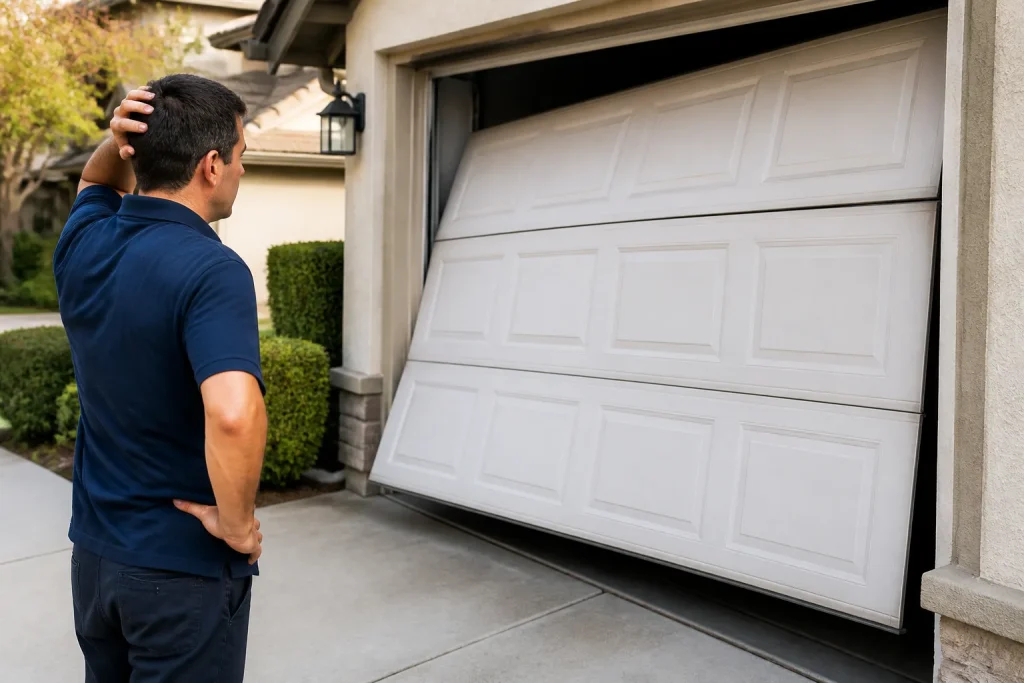
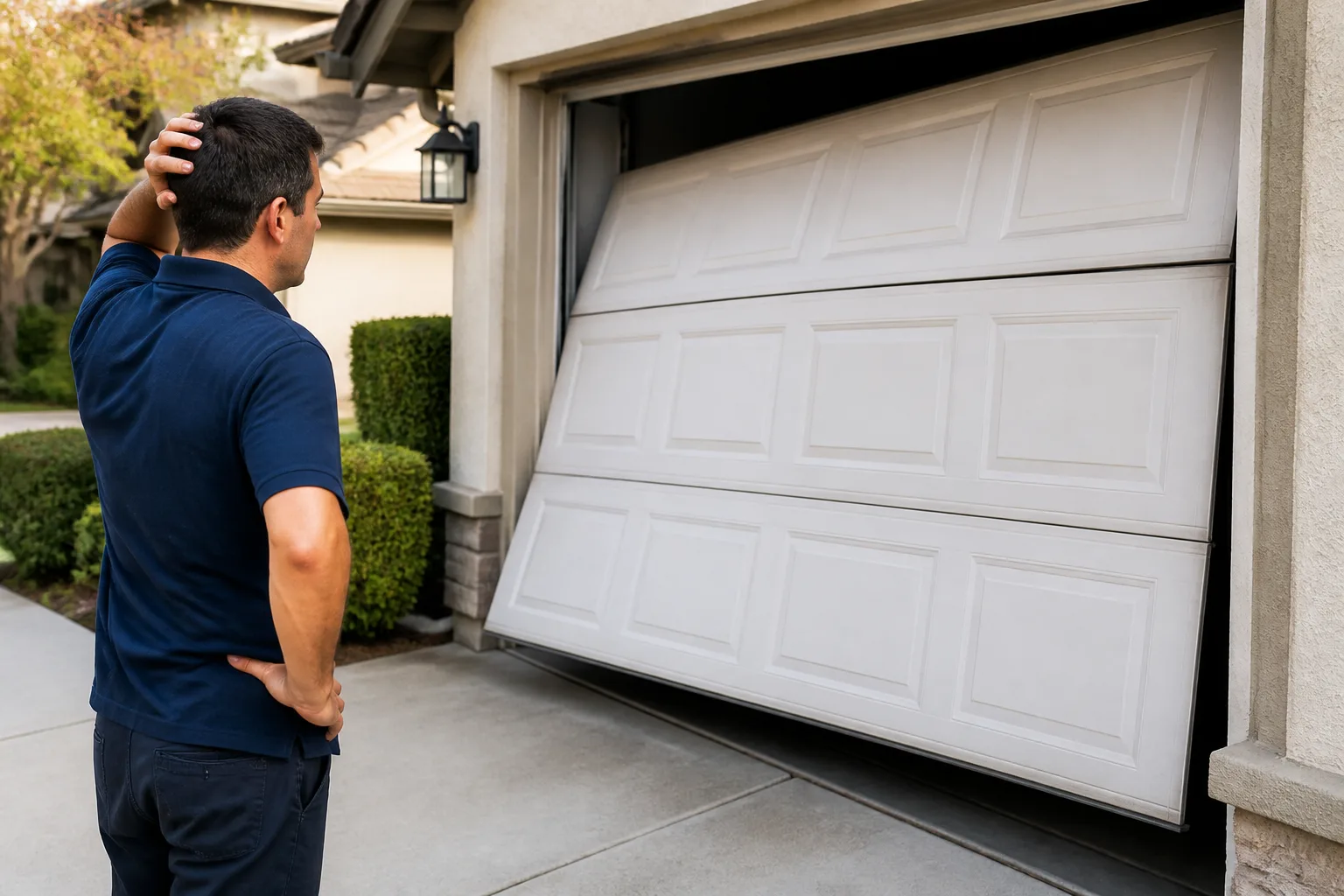
This distinction matters for your safety. When one side of the door sits lower than the other, most homeowners assume the track is bent or the rollers are off. In our experience across 393 Sacramento-area service calls, it’s almost always a broken or frayed cable.
Here’s why: each side of the door has its own lift cable, and those cables wind around a single torsion tube. If one cable snaps or slips off its drum, that side of the door loses all upward support. The other cable keeps lifting its side. The result is a door that looks like it’s “off the track” but is actually hanging by a single cable under full tension.
The DIY risk is severe. A homeowner who tries to “fix the track” by loosening hardware can release the remaining cable tension unpredictably. We’ve seen doors drop hard enough to bend the top section. The correct repair is cable replacement with the door properly secured and spring tension released safely.
Signs it’s cable failure, not track:
- The door is level at rest but tilts during opening or closing
- One cable appears slack or hangs loose when the door is closed
- The door opens at an angle but the track itself looks straight
- You hear a single loud snap, then the door operates unevenly
This is one of those times when it can’t wait. A door operating on one cable is stressing the opener, the remaining cable, and the door structure. Call for emergency garage door service rather than risk further damage or injury.
The Bottom Line
Your garage door talks to you. The lag test catches spring fatigue before the snap. Sound diagnosis points you to the right component. Reversal issues flag safety system problems that affect your family. Rust checks protect against hardware failures that ruin door sections. And recognizing an uneven door as cable failure, not track trouble, keeps you safe.
Most of these checks take five minutes. Acting on what you find saves money and prevents the 6 a.m. emergency. If you’re in Sacramento and something on this list sounds familiar, Vanguard Garage Door California offers free estimates — call (888) 430-4880. Henry runs the service calls himself, so the person diagnosing your door is the same person accountable for fixing it right.
Frequently Asked Questions
The earliest sign is a gradual slowing of your door’s opening speed — test it monthly with a stopwatch. You may also see a visible gap in the torsion spring coils, or hear a popping sound as individual coils fracture internally. In Sacramento’s heat, springs fatigue faster than in cooler climates, so that one-second lag is especially worth watching. Call (888) 430-4880 for a free tension check — we’ll tell you if it’s adjustment, replacement, or still safe.
Yes. A door operating on one cable has lost its balanced lift, which overloads the opener, stresses the remaining cable, and can cause the door to drop or jam unpredictably. The remaining cable is under full door weight and can release violently if disturbed. Stop using the door immediately and call for professional repair. We handle cable replacement with the door safely secured and spring tension properly released.
This is almost always a safety sensor or limit switch issue, not normal operation. The sensors may be misaligned, dirty, or receiving interference from direct sunlight. The opener’s close-limit setting may also be programmed incorrectly. Don’t adjust force settings yourself — incorrect calibration can create an entrapment hazard. A technician can diagnose whether it’s sensor realignment, wiring, or control board replacement.
Most common repairs fall in these ranges: spring replacement typically runs $180–$340 depending on door size and spring type; cable replacement is usually $150–$280; sensor realignment or limit adjustment runs $120–$180; opener gear repair ranges $200–$350; full opener replacement starts around $450 installed. Emergency service calls add a modest premium for after-hours response. Every job starts with a free, on-site estimate — call (888) 430-4880 to schedule.
Written by Henry Salazar, Owner & Service Manager at Vanguard Garage Door California, serving Sacramento since 2008.
Need Garage Door Help?
Call Vanguard Garage Door California — licensed & insured, here with fast after-hours help in California.
(888) 430-4880